Hello all!
This Blog is an experiment in providing regular people who own or manage a playground with a place to gain an understanding of the current state of ‘Playground Safety’.
My intent is to answer basic questions about playground upgrading so that you understand why there are new requirements for playground construction, and how known playground hazards can be eliminated without reducing the play value of your playgrounds.
I am an instructor in Playground Safety based in Canada. Canada has among the worlds most highly developed playground safety standards. I often get questions from students and owner/operators of playgrounds who are just developing their understanding of playground hazards, so this Blog is a place to delve into the issues. I do not sell anything such as equipment or surfacing, however I do consult on playground issues on a professional basis and have been teaching courses in playground safety for about ten years.
So, what IS a Playground Hazard?
A Playground hazard is a condition on a playground where a well informed adult might be able to distinguish (and change) a particular condition, a hazard, to make the playground safer when used by children. Young children are assumed to generally not be able to ‘see’ hazards. A very basic example is say a broken bottle in a playground. An adult will see this and think, “Oh, that’s not good, I should take that broken glass away”. A child might simply observe the glass but not recognize that it is a serious safety hazard. While a reasonable adult will perceive the hazard, the child may not. With the advent of computerized hospital records, conferences, and a vast number of involved adult professionals in fields such as education, child care, schools, parks departments, and the playground industry, there is now a growing body of information and understanding of a variety of preventable hazards.
But we are just now in the time of change of this understanding of hazards. This type of information is still filtering out to the millions of playground owners and operators out there.
As this Blog grows, I hope to give lots of examples of known hazards, with photographs from actual playgrounds.
Keep in mind we in the Playground Safety movement are not attempting to reduce the play value of playgrounds, but rather improve safety and reduce risk while maintaining or even improving the excitement and physical challenges all good playgrounds must have. There is a risk of injury in life. Playgrounds will not become less fun if we improve safety. They will also not become injury-free. It will cost some money to improve our playgrounds, but you know it is worth it.
Questions are welcome!
We in Parks and Recreation inevitably come around to examining where our role begins and ends. We are a diverse lot; our roles are as infinitely variable as the number of communities in which we serve. So to some extent we are a self defining group – defined in large part by our education, redefined by our interests and talents, and yet again by the input from our workplace, and broadly by our communities.
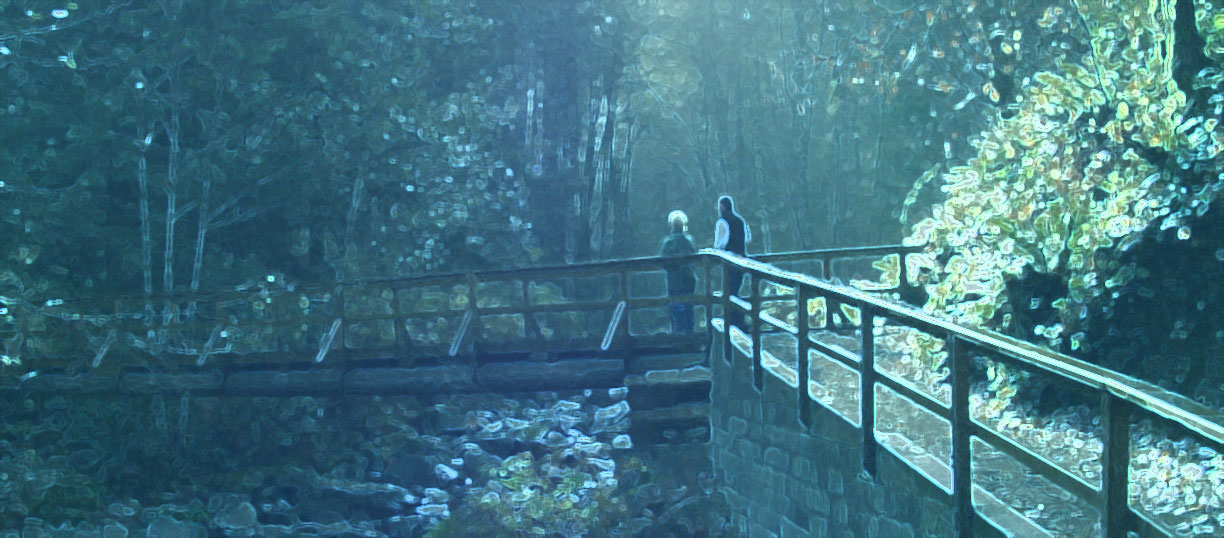 One clear direction shared by many communities of late is building linear parkways, trails and links. The aging boomer generation is now paying heed to all those ‘Participaction’ ads of yesteryear. They are turning their attention to walking in the great outdoors. This activity combines fresh air, exercise and staying close to nature. The creation of trails systems attends to our desire to get outside while often preserving areas within residential zones in a natural state.
The ‘trails facility’ should be right outside the residential front door. People are now clamoring for access to an informal fitness opportunity, and a sense of the open road – on foot.
Consider the creation of the Trans Canada Trail. It would not be possible without the age and demographic of our population. Just twenty years ago talk about a ‘Cross Canada Trail’ would have been seen in the context of Champlain and the voyageurs and a wide pioneering adventure. Nowadays anyone who can walk a few miles can undertake a small piece of the adventure – knowing that not only has someone gone before but that they have built bridges, graveled trailbeds, washrooms, and B&B’s en route. Clearly walking has arrived. Did it get here on foot?
And the connection? After Canada had been formulated from Upper and Lower Canada, It was some time before the rail link all the way across the continent was proposed. The Canadian politicians of the time took a huge, expensive gamble to build a railway stretching from sea to sea in an attempt to create a new larger nation. It was a political gamble – but made great political hay when Canada shipped out the RCMP in a record breaking seven days to quell the so-called Riel rebellion. The rail link helped bring B.C. into confederation and the iron horse was one of the leading technologies of the day. In the time before automobiles, rail freight and passenger transportation was the most desired connection.
Today, at the start of the twenty-first century we have a different slant on that connection – in the age of space travel and Mars landings, we are finding joy and satisfaction in creating a footpath from sea to sea. Low and slow. What can it mean? As a culture, we have the ability to explore space and yet we are motivated to personalize this exploration, to bring it into our own lives, to retain nature around us, to take a bit of fresh air – and go for a walk.
Several months ago I decided to do personal research on walking for this article. Let me share the results with you now. First, I have discovered that it takes hours to walk anywhere and quite often, in fact usually, I wind up back where I started! So progress, in this milieu, must be measured in some other element that mere distance covered.
With our increasingly technological society, bombarded as we are by media and stimulation, rushing forward becomes a way of life. While we rush through, we do not often savor the experience because we don’t have time before our next appointment. What sustains us in the mean time, it seems, is an intellectual agreement with ourselves that by following this course (meeting, class, job) we will either: a) get ahead, or b) we will enjoy ourselves later. Both theories work for some time. Some people make them work for a lifetime. We put off savoring the moment because it ‘makes sense’ and we tell ourselves later will do.
What I observe on the faces of walkers everywhere is a ‘letting go’ for a while, a time to forget, or begin to forget, all the hustle and bustle. To just walk for a while; to experience the randomness of nature, the beauty of the clouds, the rustle of the leaves. These sensory experiences trigger ancient responses. Combine the sights and sounds with the accelerated metabolics of a tad of exercise and you have an integrating experience, one that reverses the feeling of being just a tiny cog in civilization’s great wheel.
Walking connects us with others. Walking around the neighbourhood is a great way to become part of your surroundings, to develop a sense of belonging. Once again we learn how to savor. In communities across Canada people are reacting to the need to establish and protect their environments, and to experience them first hand, with linear pathways and green spaces.
Many communities in BC and across Canada have older play structures that can and should be upgraded in a programmed fashion to meet today’s CSA playground standards.
A frequent rationale I hear for not upgrading usually incorporate some version of “we have not had any accidents reported on this equipment, so why should we replace it before it is worn out? My response is this: One, statistics show a significant number of recorded playground accidents across Canada, from the trivial to the fatal. Two, these statistics can be used to draw significant conclusions about what particular items or conditions on the playground present hazards. Three, even though kids in your community might have avoided serious injury on your playgrounds, very few departments or staff really have any accurate idea of injury data over many years. I think this is just because those injured generally just go home – or perhaps to the hospital and only rarely, such in cases as perceived negligence do those involved contact the parks or schools management. And finally it can be very inexpensive to upgrade a playground prior to an incident rather than pay a claim following an incident.
Here is a thumbnail review of some key issues in upgrading your older playgrounds:
General Maintenance:
The most easily avoided risks are those resulting from wear and tear. A well maintained playground demonstrates at least some regular inspection and care. Contrast this with playgrounds featuring such things as worn S-hooks or rotten and damaged wooden components. Replace worn items, paint appropriately, and be on the lookout for hazards due to worn equipment.
Surfacing: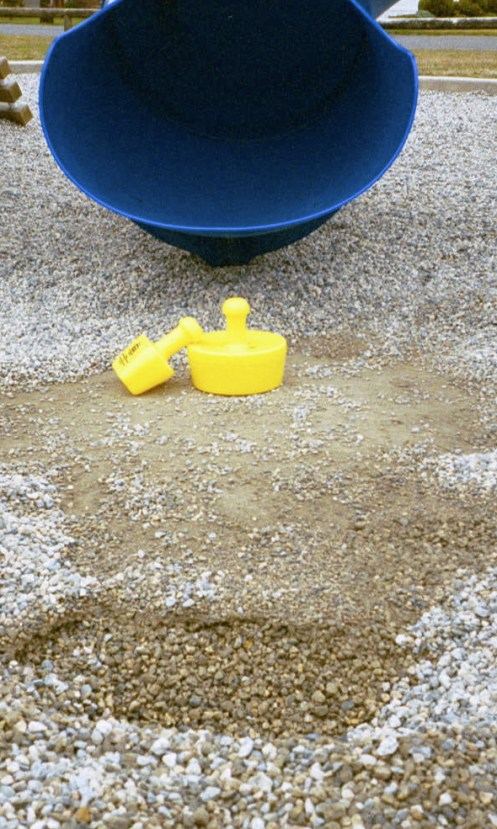

Surfacing materials should be deep! Loose fill surfacing types such as sand or pea gravel require regular maintenance to remain loose and evenly distributed. In my experience, most older playground surfaces would not pass the impact attenuation requirements of, in Canada, the CSA Standard CAN/CSA-Z614-07. Compaction can easily (and repeatedly) reduce the shock absorbing qualities of your playground, so inspect and loosen frequently.
Falls are implicated in about 70 percent of reported playground accidents. If your playground surfacing is not more or less as loose as the day it went in, it should be loosened. Professionals I talk to are either using a rototiller or a small machine such as a Bobcat with a few hardworking rakers to loosen, shovel, and spread the surfacing material evenly.
Higher quality Protective Surfacing such as Engineered Wood Fibre or specialty rubber products although more expensive provide quality shock-absorption and can be lower in maintenance costs over time.
Entrapment Issues:
Entrapment hazard exists when an opening could pass a small body but catch the relatively large head attached to that body. Using plastic probes to detect this hazard I often detect several problematic openings on older wooden climbing structures. Fortunately they are usually not difficult to close up or adjust until they conform. Entrapment can be fatal of course, and there are recorded incidents of this. Why not eliminate this risk for a few hundred dollars?
Entanglement Issues:
Entanglement is a condition in which clothing or parts of clothes such as a draw string, becomes caught on playground equipment. On a playground, a youngster who gets entangled while jumping down a sliding pole or sliding down a slide can be in grave danger if a string or garment around the neck becomes caught and pulls tight against the body’s own weight. In Canada we use a test device to check likely entanglement conditions which is intended to simulate a draw string with toggle. I have found these entanglement issues to be fairly easy to eliminate, for example by filling openings with wood, metal, or caulking.
With a reasonable approach to upgrading, you can proceed along an organized path to compliance with today’s CSA Standard for Playgrounds CAN/CSA-Z614-07 and give the children of your community all the existing excitement, fitness and adventure, but without the most serious and avoidable hazards.
Playground. Let’s look at the word. Play, something kids do to whittle away the time. Ground, the earth we walk on, in all its variations. Why add “equipment” to this naturally occurring set of circumstances? It’s all a question of standards. An acquaintance of mine was asking me the other day if there was a park up on Hardwicke Island on the British Columbia coast where I have built a log cabin. I looked at him like he was a bit strange. Why would anyone need a park on an island abounding in natural forest, beaches, birds, deer, critters of every description and a wide variety of geography?
Of course we have parks to protect and provide natural environment for numerous reasons. We add equipment to playgrounds to enhance the circumstances for play. We recognize that a simple grassy lot is often not sufficient for our children. In our urban settings we have to add back a quality that would probably be there if there were plenty of varieties of landscape to play on. And the scale of play changes as kids grow older. Kids need more room and more variety, they run faster, cover more ground and are in need of social games and more organization such as sport. So we design more equipment and build more complex facilities such as sports fields to provide a blend of opportunities. It gets complicated.
The point of my little exercise here is that there is a contrast between my island getaway where play emerges from the kids, the adults and the natural environment, versus the more urban or suburban environments where we try to build special places to play. We adults have to be very conscientious to make these play opportunities available right where kids live. That means parks and playgrounds right down the street.
And where does the community come in? How do we ensure that our community planners cooperatively plan school, park and private playground opportunities? If this is done, the children will get bigger and better play areas that are located where they are needed.
This brings me full circle in my demonstration. Up at my island cabin, the few people that come up there bring with them their sense of play and the environment provides the opportunities. As our circumstances become more urban, we must make a special provision for play and the quality of life, because, as the little guys (the Ferrengi) on Star Trek might say “it is not profitable” to build pathways, green spaces, parks and playgrounds.
As a parks or playground advocate you can speak up and raise the priority of these facilities. Playgrounds particularly need vocal advocates now as they are being rebuilt in recognition of playground standards. Playground standards emerge from huge volumes of accident statistics.
Play is the spark plug in a child’s life. If we must provide areas for this play, why not advocate for a gold standard in your community?
 Playground Info